Die Employee Turnover Rate ist ein KPI, der häufig dann ins Spiel gebracht wird, wenn Mitarbeiter das Unternehmen verlassen. Im Folgenden wird erläutert, was es mit diesem Key Performance Indicator auf sich hat und wie man ihn berechnet.



Die Employee Turnover Rate ist ein KPI, der häufig dann ins Spiel gebracht wird, wenn Mitarbeiter das Unternehmen verlassen. Im Folgenden wird erläutert, was es mit diesem Key Performance Indicator auf sich hat und wie man ihn berechnet.
Die Employee Turnover Rate ist ein KPI, der häufig dann ins Spiel gebracht wird, wenn Mitarbeiter das Unternehmen verlassen. Im Folgenden wird erläutert, was es mit diesem Key Performance Indicator auf sich hat und wie man ihn berechnet.
Die Employee Turnover Rate (auf Deutsch “Mitarbeiterfluktuationsrate”) ist ein KPI im HR- und Recruiting-Bereich, der Aufschluss über die Mitarbeiterfluktuation gibt. Sie verdeutlicht, wie hoch die Anzahl der personellen Austritte pro Jahr ausfällt. Die Zahl der ausgeschiedenen Mitarbeiter wird ins prozentuale Verhältnis zum Personalbestand bei Jahresbeginn gesetzt. Damit ist dieser Key Performance Indicator für Personalplaner von großer Bedeutung.
Wichtig: Die Fluktuation kann sowohl freiwillig, also auf Initiative des Arbeitnehmers, als auch unfreiwillig (durch Kündigung oder Auslaufen des Arbeitsvertrags) erfolgen.
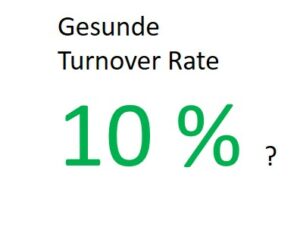 Diese Frage lässt sich nur schwer beantworten. Die Fluktuationsrate hängt nämlich mit unterschiedlichen Faktoren zusammen, bspw. Branche, Standort oder Durchschnittsalter der Mitarbeiter. Im Netz stößt man allerdings immer wieder auf eine Turnover Rate von 10 Prozent, die „gesund“ sein soll.
Das Problem bei solchen Angaben: Man muss bei der Fluktuation vor allem auch darauf schauen, WER das Unternehmen verlässt. Es kann bspw. gravierende Auswirkungen auf den Unternehmenserfolg haben, wenn eine zentrale Führungskraft mit Schlüsselfunktion geht.
Es empfiehlt sich, bei der Frage nach einer „guten“ oder „schlechten“ Turnover Rate einen Blick auf die Konkurrenz zu werfen und zu schauen, wie hoch die Fluktuationsraten bei den Wettbewerbern sind.
Es gibt unterschiedlichste Ansätze, um die Fluktuationsrate zu berechnen. Eine häufig angewandte Formel: Man teilt die Zahl der Kündigungen in einem bestimmten Zeitraum durch die Zahl der Angestellten zu Beginn dieses Zeitraums.
Beispiel: Startet man das Jahr mit 100 Beschäftigen und im Laufe des Jahres verlassen 20 Personen das Unternehmen, so lautet die Rechnung 20:100 = 0,2. Die Turnover Rate beträgt damit 20 %.
-> Zurück zum Recruiting Glossar